
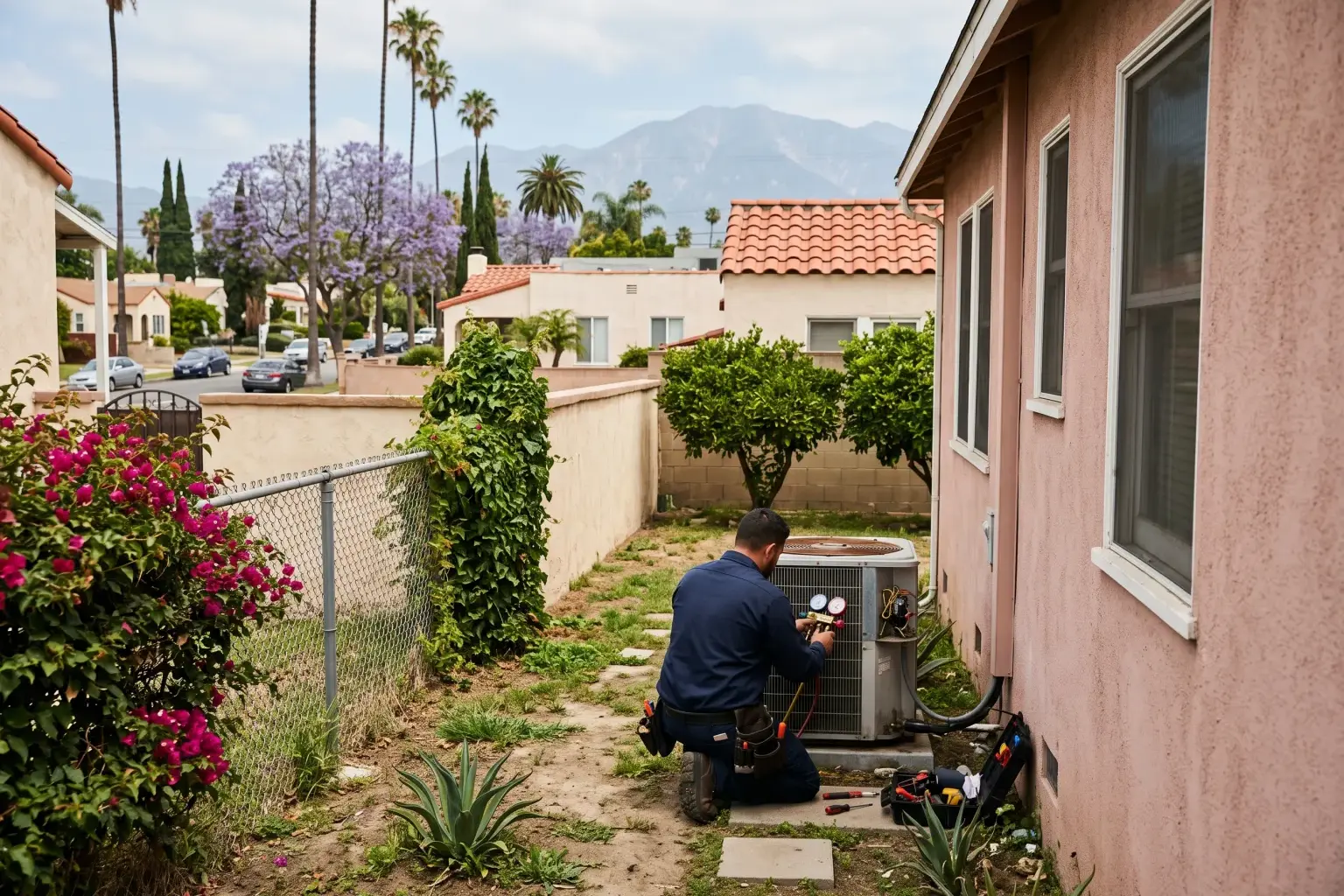
The short answer
If your AC is blowing warm air, running nonstop, leaking, or making new noises, it likely needs a diagnosis and repair. EverClime HVAC Contractor inspects the whole system, explains what failed and why, and gives you repair options, and replacement options when they make sense, before any work begins.
When your air conditioner stops cooling, you want to know three things: what's wrong, what it will take to fix, and whether the system is worth keeping. EverClime HVAC Contractor repairs central air conditioners, heat pumps, and ductless systems for homeowners across Los Angeles and surrounding cities. Summers here are dry, and inland neighborhoods and valleys run much hotter than areas near the coast. That means a system in the Valley often works harder than the same unit a few miles from the beach. Fall Santa Ana winds can also bring hot, dry spells after you thought cooling season was over. This page covers the warning signs to watch for, what our technicians check, how we help you choose between repair and replacement, and what to expect when we come out.
Signs Your AC Needs Repair
Many AC problems start small. Catching them early often means a simpler repair and a lower chance of a breakdown on the hottest day of the year.
If you smell burning or the breaker keeps tripping, turn the system off at the thermostat and leave it off until it's checked. Before you call, confirm that the thermostat is set to cool, that its batteries are good, and that the air filter isn't clogged. Those three things cause more no-cooling calls than most people expect.
- Air from the vents feels warm or only slightly cool
- The system runs constantly, but the house never reaches the set temperature
- Weak airflow from some or all vents
- Short cycling, where the unit turns on and off every few minutes
- Ice on the refrigerant lines or the indoor coil
- Water pooling near the indoor unit, or a ceiling stain below an attic unit
- Grinding, squealing, buzzing, or banging from the outdoor unit
- A burning or musty smell when the system starts
- The breaker trips when the AC kicks on
- Electric bills rising without any change in how you use the system
What We Check During an AC Repair Visit
We diagnose before we recommend anything. A technician looks at the whole system, because the part that failed isn't always the root cause. A burned-out fan motor, for example, can be a symptom of a failing capacitor or a dirty coil.
Dust and dry conditions in much of the region make dirty condenser coils and clogged filters common contributors to breakdowns. When we find low refrigerant, we look for the leak instead of just adding more. A system that's low on refrigerant will keep losing it until the leak is repaired.
- Thermostat settings, wiring, and calibration
- Air filter, blower motor, and blower wheel
- Evaporator coil, condensate drain line, drain pan, and float switch
- Refrigerant pressures and signs of a leak
- Outdoor condenser coil, fan motor, and fan blade
- Capacitors, contactor, and electrical connections
- Compressor operation and electrical draw
- Accessible ductwork for disconnected, crushed, or leaking sections
- Temperature difference between return air and supply air
Repair or Replace: Your Options
Most AC problems are repairable, and we'll tell you when a repair is the sensible choice. Replacing a capacitor, clearing a drain line, or swapping a fan motor can restore a system that still has plenty of life left.
Replacement is worth discussing when the compressor or indoor coil has failed on an older system, when the same problems keep coming back, when the system uses an older refrigerant that's harder to service, or when the unit can't keep up with your home on hot inland days. We'll explain the trade-offs so the decision is yours.
If you replace, a heat pump is one option to consider because it handles both cooling and heating. LADWP residential electric customers can apply for Consumer Rebate Program rebates on qualifying heat pump systems, with the amount based on the unit's SEER2 and HSPF2 efficiency ratings. The application is filed after the equipment is purchased and installed, within 12 months of purchase. Many homes outside the City of Los Angeles are served by Southern California Edison instead, so the rebates available to you depend on your utility. We confirm the current offer before quoting it.
Two other points matter for planning. The federal Energy Efficient Home Improvement Credit (25C) covered qualifying heat pumps placed in service before December 31, 2025, and it isn't available for new installations now. If your project also involves replacing a gas furnace, South Coast AQMD Rule 1111 limits emissions from gas furnaces sold and installed in the region. The district has been moving the rule toward zero-emission requirements and revises compliance dates, so we'll check the current rule with you before you choose equipment.
What Affects the Cost of AC Repair
You get a clear quote before any work begins. Every system is different, and these are the main factors that shape the cost of a repair:
If the repair cost starts to approach the cost of moving to a new system, we'll lay out both paths side by side so you can compare.
- Which part failed. A capacitor or contactor is a simpler fix than a compressor or coil.
- Whether the parts are in stock or need to be ordered
- Refrigerant type, how much is needed, and the time required to find and fix a leak
- Access to the equipment. Attic, crawlspace, rooftop, and tight side-yard installations take longer.
- System type and age, including ductless and older equipment
- Whether ductwork or electrical problems are part of the issue
- Timing, such as after-hours service requests
How an AC Repair Visit Works
We keep the process simple and explain each step as we go.
To help the visit go smoothly, clear a path to the thermostat, the indoor unit, and the outdoor unit. Write down any error codes or blinking lights you've noticed, and keep pets secured while the technician works.
- Schedule: Tell us what you're noticing, when it started, and what type of system you have.
- Diagnose: The technician inspects and tests the system, then explains the findings in plain language.
- Review options: You get repair options and a quote before any work starts, plus replacement options if they make sense.
- Repair: With your approval, we complete the work, often during the same visit when parts are on hand.
- Test and review: We run the system, check temperatures and airflow, and walk you through what was done.